
REVIEW · CHICAGO NEIGHBORHOOD TOURS
Retro River North Walking Tour
River North glows when you walk it. This Retro River North tour strings together vintage signage with Chicago architecture in a way that makes the neighborhood feel like a storybook. With the guide (Ronnie), you get design-focused storytelling that points out details you’d otherwise walk right past.
What I like most is the mix of big-name landmarks and character storefronts, all in a tight time window. You’ll also get that signature Chicago-photo payoff: stops are handpicked for looks and for lingering at the right spots, with extra visual material available through the free app. The second thing I really appreciate is that the first chunk of the tour is admission-free, so you can enjoy the major interior stops without adding surprise costs.
One consideration: not every stop’s entry is included. The later music-and-entertainment stops (Redhead Piano Bar, Hard Rock Cafe, and House of Blues) list admission tickets as not included, and alcoholic drinks are also not part of the tour price—so plan for a little budget if you want to go inside and stay awhile. Also, this experience requires good weather.
In This Review
- Key things to know before you go
- Why this River North walk fits a 6:00 pm start
- How the mobile ticket and small group changes the experience
- Stop 1: St. James Cathedral and the Lincoln-to-Fire connection
- Stop 2: Richard H. Driehaus Museum inside the Nickerson House
- Stop 3: The Murphy Auditorium and those Tiffany Studios doors
- Stop 4: Tree Studio Complex and the Ivy Room effect
- Stop 5: P.O.S.H and the Paris flea-market vibe
- Stop 6: Redhead Piano Bar and its neon-first personality
- Stops 7 and 8: Hard Rock Cafe and House of Blues, music as a design language
- The best way to plan your dinner afterward at Tortoise Supper Club
- Value check: Is this really worth $0?
- Who this tour suits best
- Should you book Retro River North?
- FAQ
- How long is the Retro River North Walking Tour?
- What time does the tour start?
- Where does the tour start?
- Where does the tour end?
- How much does the tour cost?
- Is this tour a mobile ticket experience?
- What is included with the tour?
- What is not included in the tour price?
- How many people are in the group?
- Is the tour near public transportation?
- Do I need good weather for this tour?
Key things to know before you go
- Small group size (up to 8) means more personal attention and easier photo stops.
- Free app historical photos give you a quick before-and-after view at each stop.
- First stops are admission-free, including the St. James Cathedral and Driehaus Museum area.
- Murphy Auditorium includes photo access for interior views during the tour.
- Neon and vintage signage are a main theme, especially around Redhead Piano Bar.
- Later stops can cost extra, since some admission tickets and drinks are not included.
Why this River North walk fits a 6:00 pm start
A 6:00 pm start is smart for this neighborhood. River North is at its best when evening light starts to hit facades and window displays, and the neon signs start feeling less like background and more like the main event. In about two hours, you’ll move from landmark architecture to smaller, quirky spaces without turning it into a long grind.
The schedule also works for people who want “one solid activity” and then dinner/drinks after. The tour ends at the Tortoise Supper Club (350 N State St), near the Chicago River on State Street by Marina City, so you’re not stuck wandering too far afterward. If you like a plan with momentum, this delivers.
You’ll be walking at an evening pace, and the tour lists a moderate physical fitness level—so it’s not for people who want zero motion, but it doesn’t require marathon energy either. And since the group max is 8, the pace is usually easier to handle than big-bus sightseeing.
Past the downtown core, more neighborhoods
How the mobile ticket and small group changes the experience
This is a mobile-ticket tour. That sounds simple, but it matters in the real world: you spend less time at checkpoints and more time actually looking at the buildings and signs that the walk is built around.
Group size is another underrated quality. With up to 8 people, you’re more likely to hear the guide’s details clearly and get help spotting the stuff that makes each stop special—like a specific doorway, a particular architectural clue, or the exact vibe of an old-school storefront. Based on the way Ronnie is described in the tour feedback, he has that habit of connecting design choices to Chicago’s bigger story, and smaller groups make that kind of talk land better.
One practical note: the tour is near public transportation. So if you’re staying downtown, you can usually mix this into a broader day without committing to a whole second commute.
Stop 1: St. James Cathedral and the Lincoln-to-Fire connection
St. James Cathedral sets the tone by doing something Chicago does so well: it compresses major eras into one physical place. You learn that Abraham Lincoln worshipped at St. James shortly after his election in 1860. That alone turns the church from “just another historic building” into a time machine moment.
After the Civil War, the church saw tremendous growth, leading to enlargement and a grand redecorating. Then came the Great Chicago Fire in 1871. The key detail here is what the fire did and didn’t destroy: it left nothing but the stone walls and the bell tower, whose bells warned the neighborhood of the fire. It’s a heavy story, but it also explains why the architecture has that specific blend of survival and reinvention.
This stop is listed with free admission, and the time on-site is about 15 minutes. That’s enough time to catch the setting and take it in without turning the tour into a museum marathon.
Chicago at sidewalk speed, more routes
- Chicago: Gangsters and Ghosts Walking Tour
★ 5.0 · 7,155 reviews - Chicago Favorites Ultimate Food and Walking Tour
★ 5.0 · 1,962 reviews - Chicago: Gangsters and Ghosts Guided Walking Tour
★ 4.7 · 1,697 reviews
Stop 2: Richard H. Driehaus Museum inside the Nickerson House
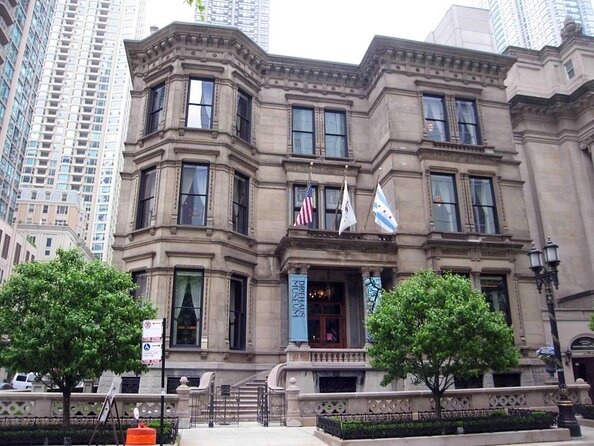
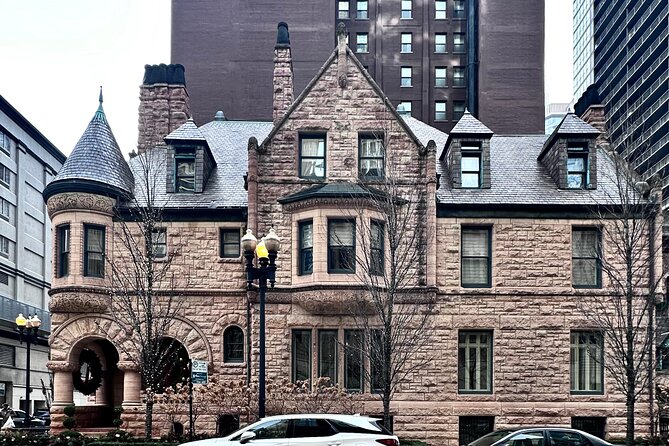
From St. James, you shift from church-scale grandeur to mansion-scale ambition at the Richard H. Driehaus Museum. It’s housed in the historic Samuel M. Nickerson House, built in 1883 for the wealthy Chicago banker Samuel M. Nickerson.
The house was designed by Edward J. Burling, one of Chicago’s early prominent architects (Burling & Whitehouse). Construction took four years and cost $450,000—reportedly the most expensive and elaborate private residence in Chicago at the time it was completed in 1883. That price detail isn’t just trivia. It helps you understand why the building feels so determined to impress.
Inside, you’re told the interiors are spectacular, with materials and finishes that Chicago rarely does halfway: marble, onyx, carved exotic and domestic woods, glazed tiles, and stained glass. You’ll also see original furnishings from the Nickerson era, along with collections tied to American life and style from that period.
This is another free-admission stop. For me, that’s part of the tour’s best value: the route gives you high-production, inside-the-building experiences without pushing a ticket fee at you every five minutes.
Stop 3: The Murphy Auditorium and those Tiffany Studios doors
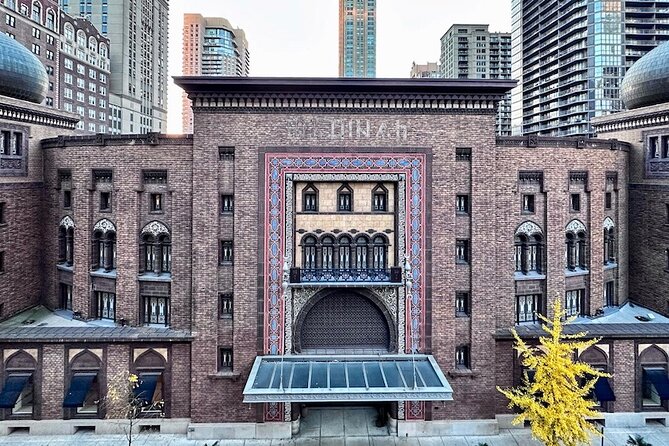
Next up is The Murphy Auditorium, built between 1923 and 1926 by the American College of Surgeons. It was designed by Benjamin Marshall and Charles E. Fox of the firm Marshall and Fox—the same architects credited with the Edgewater Beach Apartment building, often called the Pink Palace.
This building is now part of the Driehaus Museum footprint (added in 2022), which is one reason it can feel like a “bonus” architecture stop rather than an isolated detour. It’s also the kind of place that rewards a slow look at entry details.
One highlight: the front entrance has a pair of cast bronze doors produced by Tiffany Studios. That’s not a small flourish—Tiffany-branded metalwork tends to signal you’re standing at a gateway meant to impress.
The tour also notes that you’ll have photos of the interior available during the walk. That’s a smart workaround when you’re doing this on foot in limited time: you still get the visual impact without losing the group to long lines.
This stop stays at around 15 minutes and is free for admission.
Stop 4: Tree Studio Complex and the Ivy Room effect
The Tree Studio Complex is commissioned history made for artists. The studios were commissioned in 1894 by Judge Lambert Tree and his wife Anna Field Tree—daughter of Marshall Field. The whole concept was an artists’ residence, and the complex has housed over 500 artists.
A building with that kind of resident history changes how you experience it. You’re not just looking at brick—you’re imagining who worked there, who practiced there, and who used that space as a daily tool.
You’ll likely recognize one of the most famous rooms associated with Tree Studios: the Ivy Room, which is known as a spectacular venue for events and especially weddings. Even if you’re not attending an event, hearing that name in the context of the complex helps you understand why it has such a strong cultural reputation.
The tour also shares a long list of artists connected to the studios, including sculptors Albin Polasek and John Storrs, illustrator J. Allen St. John, muralist John Warner Norton, painters Ruth Van Sickle Ford, John Singer Sargent, and Pauline Palmer, plus actors Peter Falk and Burgess Meredith. That range matters. It’s not only fine art painters; it’s a whole creative ecosystem.
Like the earlier stops, this one is listed as free admission and runs about 15 minutes.
Stop 5: P.O.S.H and the Paris flea-market vibe
After the formal grandeur of churches, mansions, and auditoriums, P.O.S.H brings it back to everyday character. The shop opened in 1997 with a clear aim: offer something unique instead of the coast-to-coast sameness people get tired of.
Here’s what makes the stop interesting: the inventory is described as authentic and eclectic—vintage hotel and estate silver, restaurant china, dinnerware, and a rotating mix of European flea market finds. That means you’re not looking at a single style category; you’re looking at collected objects, the kind you’d only stumble upon by hunting for them.
The tour also sets up a specific mood. When you step inside, it’s designed to feel like a Parisian-type flea market. And in the back of the shop, you can catch a glimpse into the courtyard of the Tree Studios. So even though you’re in a commercial space, you’re still connected visually to the larger creative campus next door.
This stop is also around 15 minutes with free admission.
Stop 6: Redhead Piano Bar and its neon-first personality
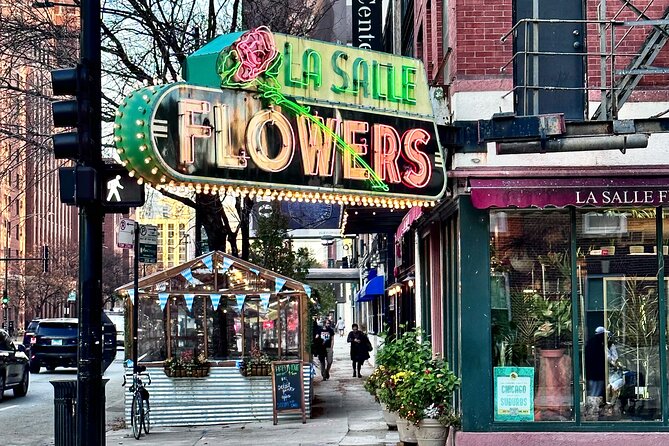
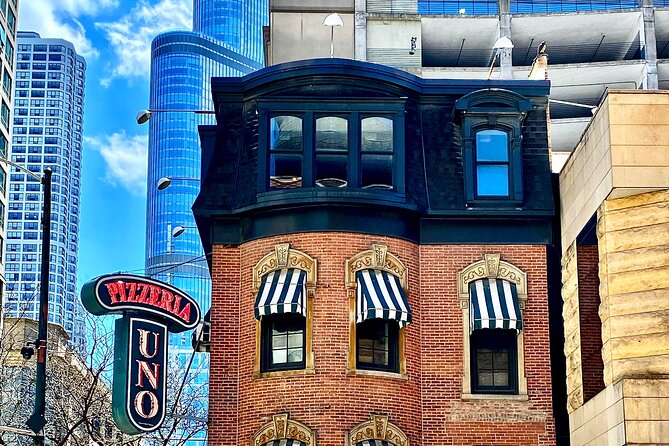
Now the tour leans hard into the nightlife theme. Redhead Piano Bar is known for a cool, vintage neon sign, tucked on Ontario Street. It’s been a neighborhood mainstay since 1993, with live piano music nightly.
If you love places that feel like they have a memory, this is the stop. The bar is described as a cocktail piano bar dressed in yesteryear memorabilia, which is exactly the kind of atmosphere that makes neon feel more than decoration.
One practical thing: the tour lists admission ticket not included for this stop. That doesn’t mean the stop is pointless—it can still be worth it for the sign and the vibe—but it does mean you should assume you’ll pay separately if you want to stay for the music or go further inside.
This stop is brief (about 15 minutes), so it works best as an atmosphere sampler right before you choose your next move.
Stops 7 and 8: Hard Rock Cafe and House of Blues, music as a design language
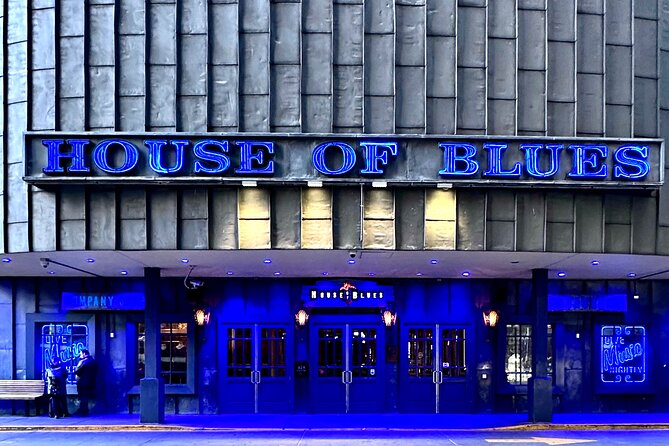
Hard Rock Cafe Chicago and House of Blues Chicago take the tour’s theme—signs, culture, and entertainment—and turn it into a visual museum of pop culture.
At Hard Rock Cafe Chicago, the iconic giant guitar in the parking lot is the anchor landmark. The cafe has been operating for more than 30 years as a dining, entertainment, and shopping destination known worldwide. The walls are lined with music memorabilia, tied to major legends like Billy Joel, Buddy Guy, Jimi Hendrix, and Prince. The point here isn’t just fame; it’s how the cafe turns music history into physical space.
House of Blues Chicago, meanwhile, carries a mission statement that goes beyond events. It was founded around 30 years ago with a mantra: Unity in Diversity. The tour notes that the organization’s cultural development has aimed for peace, love, community, and acceptance, and that it continues to advocate for human expression, racial equality, and spiritual harmony.
Both of these stops list admission tickets as not included. So think of them as optional add-ons if you want to pay to go inside and spend more time. If you’re keeping the evening tight, you can still use them as landmarks for photos and orientation.
The best way to plan your dinner afterward at Tortoise Supper Club
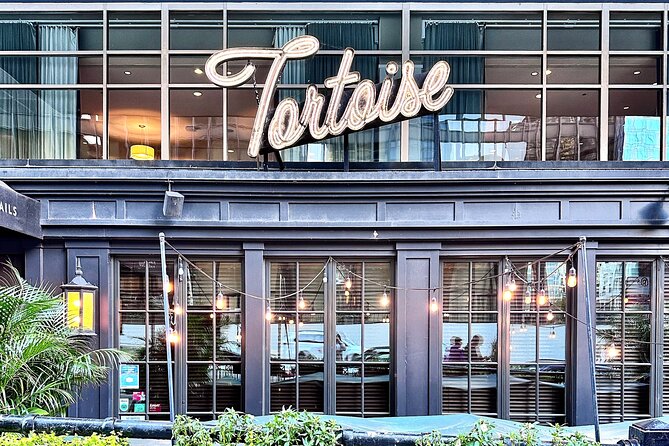
The tour ends at Tortoise Supper Club at 350 N State St, near the Chicago River on State Street by Marina City. That end point is practical. You’ve got a full neighborhood behind you, and you can pick your meal without needing a second transit plan.
Also, the tour info notes that food and beverages ordered afterward aren’t included in your tour price if you go to jazz at Tortoise. That’s not a surprise, but it’s useful to know: treat it as your next bill, not part of the tour.
If you want a smooth night, you’ll be happiest if you plan for a split evening:
- one part architecture/neon walking,
- one part dinner and live music, if you want it.
That’s the real payoff of ending at a music-and-food venue rather than at a hotel lobby.
Value check: Is this really worth $0?
The listed price is $0.00 per person, which is rare for a walking tour that hits major architecture stops. That said, the value comes with a clear structure: the early, major sights are free-admission, while later entertainment stops and drinks are not included.
So here’s the balanced way to think about it. You’re not paying for a ticket that covers everything. You’re paying with your time, and you’re benefiting from guide storytelling plus free access to key cultural buildings and free photo resources via the app.
If you’re the kind of traveler who likes to learn quickly and then spend more money on what you truly want (like a piano bar cover or a meal at the end), this format is a win. If you prefer everything prepaid with zero extra decisions, you may find the not-included items slightly annoying—but the tour duration and limited number of paid stops keeps it manageable.
Who this tour suits best
This is a great fit if you:
- love neon signs and vintage street-level details,
- want architectural context without sitting through a long museum day,
- prefer small groups and clear guide direction,
- like a planned walk that ends near a place to eat and relax.
It’s less ideal if you:
- want to avoid all venues where admission might not be included,
- expect every stop to be fully inside and fully paid for,
- need a very slow, low-walking pace.
Given the moderate fitness requirement and the 1 hour 40 minutes to 2 hours window, plan on comfortable shoes and a light outer layer if Chicago gets chilly.
Should you book Retro River North?
I’d book it if you want River North’s neon-and-architecture side in one compact evening, and especially if you appreciate when a guide points out design choices and tells the stories behind them. The free price plus free-admission major stops makes it hard to beat for value, and the small group size helps the tour feel personal rather than rushed.
I’d hesitate only if you dislike the idea that later entertainment stops may cost extra, or if weather can be a problem for your dates. If you’re flexible and you’re happy to spend a little more only where you actually want to stay, this tour is a smart bet.
FAQ
How long is the Retro River North Walking Tour?
It lasts about 1 hour 40 minutes to 2 hours.
What time does the tour start?
The start time is 6:00 pm.
Where does the tour start?
It starts at 731 N La Salle Dr, Chicago, IL 60654.
Where does the tour end?
It ends at Tortoise Supper Club, 350 N State St, Chicago, IL 60654, near the Chicago River on State Street by Marina City.
How much does the tour cost?
The price is listed as $0.00 per person.
Is this tour a mobile ticket experience?
Yes, the tour uses a mobile ticket.
What is included with the tour?
You get historical photos of each stop in a free app.
What is not included in the tour price?
Alcoholic beverages are not included. Admission ticket for Redhead Piano Bar, Hard Rock Cafe Chicago, and House of Blues Chicago is also not included.
How many people are in the group?
The maximum group size is 8 travelers.
Is the tour near public transportation?
Yes, it is near public transportation.
Do I need good weather for this tour?
Yes. The experience requires good weather, and if it’s canceled due to poor weather, you’ll be offered a different date or a full refund.
Chicago on Foot, Block After Block
- Chicago: Gangsters and Ghosts Walking Tour★ 5.0 · 7,155 reviews
- Chicago Favorites Ultimate Food and Walking Tour★ 5.0 · 1,962 reviews
- Chicago: Gangsters and Ghosts Guided Walking Tour★ 4.7 · 1,697 reviews
- Chicago in a Day: Food, History & Architecture Walking Tour★ 5.0 · 1,153 reviews
- Chicago’s Secret Interiors Architectural Walking Tour★ 5.0 · 635 reviews
The Wider Chicago Shortlist
- Chicago Architecture River Cruise★ 5.0 · 15,756 reviews
- Chicago River 90-Minute Architecture Tour★ 4.5 · 9,629 reviews
- Chicago River: 1.5-Hour Guided Architecture Cruise★ 4.8 · 8,046 reviews
- Chicago: Gangsters and Ghosts Walking Tour★ 5.0 · 7,155 reviews
- Chicago Architecture Center River Cruise aboard First Lady★ 5.0 · 5,536 reviews
Out Into the Neighborhoods
- The Escape Game Chicago: Epic 60-Minute Adventures in River North★ 5.0 · 332 reviews
- Bike Tour of Chicago’s Lakefront Neighborhoods★ 5.0 · 241 reviews
- Chicago: Lakefront Neighborhoods Bike Tour★ 4.9 · 123 reviews
- River North Food Walking Tour★ 4.5 · 88 reviews
- Small-Group Tour of Chicago Neighborhoods: North and South Side★ 4.5 · 50 reviews
The Ink Is Still Wet on These Chicago Reviews



Chicago Neighborhood Tours, compared.
 ★ 5.0The Escape Game Chicago: Epic 60-Minute Adventures in River NorthFrom $47332 reviews
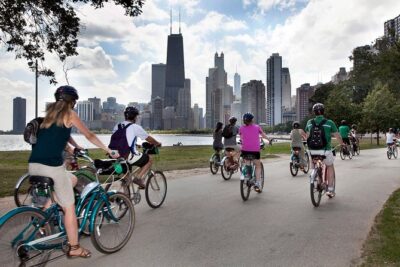 ★ 5.0Bike Tour of Chicago’s Lakefront NeighborhoodsFrom $59241 reviews
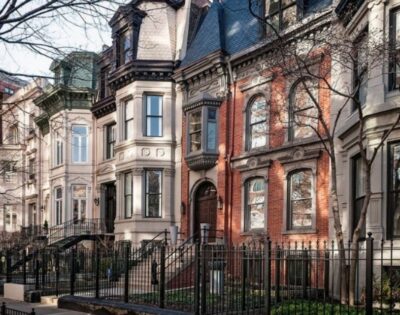 ★ 4.9Lakefront Neighborhoods Bike TourFrom $59123 reviews
 ★ 4.5River North Food Walking TourFrom $8988 reviews
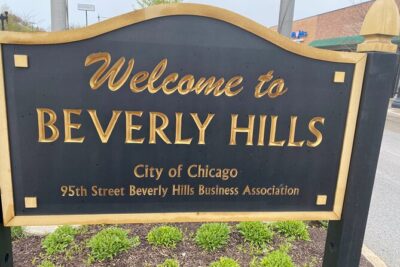 ★ 4.5Small-Group Tour of Chicago Neighborhoods: North and South Side50 reviews
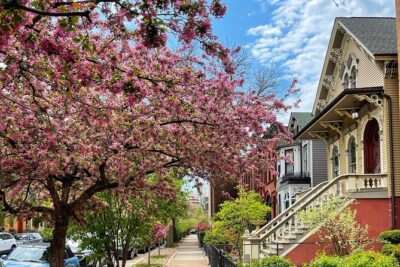 ★ 5.0Workers Cottages of Oldtown Triangle Walking TourFrom $4545 reviews
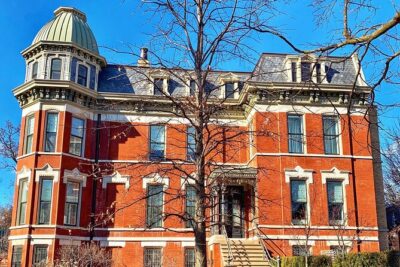 ★ 5.0Historic Homes and Cottages of Wicker Park Walking TourFrom $4544 reviews
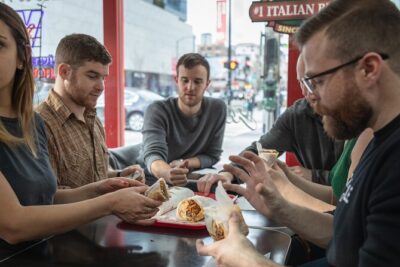 ★ 5.0Chicago Neighborhood Food Private Walking TourFrom $24521 reviews
Browse the lists this tour appears in