
REVIEW · SELF-GUIDED TOURS
Eastside Chicago The Heist Exploration Game and Tour
Millennium Park turns into a clue hunt. The Eastside Chicago The Heist Exploration Game and Tour is a self-guided smartphone adventure that sends you through some of downtown Chicago’s most famous art and monuments without waiting on a group or a guide.
I especially like the offline-friendly gameplay (so you can keep going even if signal is spotty). I also like the private, no-human-contact setup, which helps you dodge the usual crowd crush around the big sights.
One thing to consider: you’re on foot and you need decent phone cooperation in real-world conditions. If construction blocks a path or you fall out of range near a stop, you may have to use hints and that can reduce the fun.
In This Review
- Key highlights to know before you go
- How the heist game feels in real life (and why it works)
- Price and time: $7.20 for 1 hour 35 minutes—what you really get
- Start point: how to set yourself up at 111 S Michigan Ave
- The Art Institute clue: where Chicago’s rebuilding story begins
- Calder and the red-orange flying dragon: public art you can actually locate
- Crown Fountain: the trick is watching the water work
- Cloud Gate: a reflective sculpture that turns the skyline into the artwork
- Wrigley Square and the Millennium Monument: a classic Chicago monument story
- Lurie Garden: built on buried layers after the Great Fire
- Chicago Stock Exchange Arch: a survivor fragment with big symbolism
- Buckingham Fountain: why it’s a must-stop even without a show
- Lincoln statue in Grant Park: the mood matters
- Taft’s Fountain of the Great Lakes: a finishing stop with first-commission context
- Pritzker Military Museum & Library: a sharper turn in tone
- The not-so-perfect parts: walking, phone range, and construction days
- Who should book this heist game—and who might prefer something else
- Should you book this tour?
- FAQ
- How much does Eastside Chicago The Heist Exploration Game and Tour cost?
- How long is the tour?
- Is there a physical guide with you?
- Do I need internet access to play?
- Where does the tour start and end?
- Can I start whenever I want?
- Is this tour private?
- What language is the experience offered in?
- Can I cancel for a full refund?
Key highlights to know before you go
- Self-guided heist route through major landmarks in the Loop area and nearby Grant Park sites
- Play offline using your smartphone, with mobile tickets for the game
- Private group experience with no in-person guide and no human contact
- Start anytime with flexible pacing and the ability to pause and resume
- A low price for a full walking loop (about 1 hour 35 minutes) with lots of stops
- Plan for walking and stay aware of construction and temporary barriers
How the heist game feels in real life (and why it works)
This isn’t a sit-and-listen tour. It’s a puzzle-style walk, where you move from spot to spot and answer challenges tied to what you’re seeing. Think of it as learning Chicago at the speed you want—slow, stop-and-photo, or fast and focused.
The biggest practical win is the format: you’re not tied to a guide’s script or the pace of a bigger group. The tour is set up so your group plays privately, and you have full flexibility to start at any time and even pause, then resume later. That matters in Chicago, where weather, crowds, and your own energy can change fast.
The other win is that the game is built to work without needing an internet connection. That’s huge downtown, where you can go from full bars to nothing at all just by stepping into the wrong gap between buildings. Offline play means you’re less likely to lose momentum mid-riddle.
Chicago at your own pace, more options
Price and time: $7.20 for 1 hour 35 minutes—what you really get
At $7.20 per person for about 1 hour 35 minutes, this is priced like a budget-friendly activity, not a pricey “guided tour.” For that cost, you’re buying two things:
1) Access to a smartphone game that turns multiple landmarks into mini learning stops.
2) The convenience of a route that doesn’t require you to coordinate with other people.
If you’re already planning to spend time in Millennium Park and the nearby Grant Park area, the value becomes clearer: you’re not paying to enter a museum or a fountain show. You’re paying for a structured walk that helps you notice details you might otherwise skim past.
One caution: because it’s self-guided and clue-based, you need to be willing to read your screen while you walk. If you prefer a hands-free experience with a person explaining everything, this may feel more like a scavenger hunt than a tour.
Start point: how to set yourself up at 111 S Michigan Ave
The game starts at 111 S Michigan Ave, Chicago, IL 60603 and ends at Fountain of the Great Lakes, E Jackson Blvd, Chicago, IL 60603. The route is timed like an easy downtown loop: you’ll be moving between major sites spread across the central area, so comfortable shoes are not optional.
Also, you’ll want to give yourself a small buffer for the first few clues. Early on, the game is teaching you how it wants you to move, where it expects you to stand, and how strict the “you’re in the right spot” checks can be.
- Chicago Architecture River Cruise
★ 5.0 · 15,756 reviews - Chicago River 90-Minute Architecture Tour
★ 4.5 · 9,629 reviews - Chicago River: 1.5-Hour Guided Architecture Cruise
★ 4.8 · 8,046 reviews
The Art Institute clue: where Chicago’s rebuilding story begins
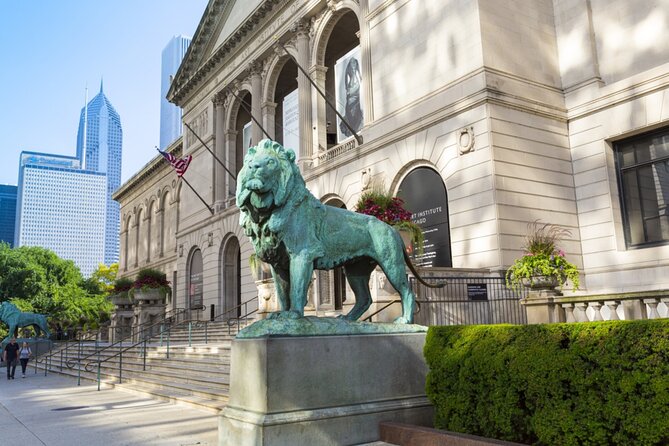
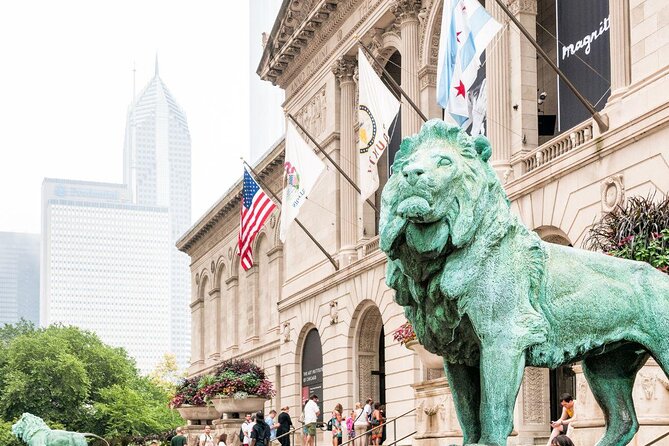
You’ll begin with a stop at the Art Institute of Chicago, founded in 1879 as both a museum and school for the fine arts. That detail is more than trivia. It explains why Chicago’s art scene didn’t just arrive with museums—it grew alongside the city’s civic rebuilding after the Great Fire of 1871.
In your game, you’ll be asked to look around and find the answer to a challenge that advances you to the next location. The helpful part of this stop is the way it nudges you to slow down. You’re not just walking past a famous building; you’re actively scanning for what the question is pointing at.
Calder and the red-orange flying dragon: public art you can actually locate
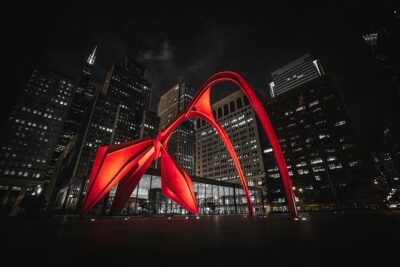
Next comes a stop tied to Alexander Calder (1898–1976) and his public work in Chicago. You’ll focus on the Flying Dragon, known for the signature red-orange color Calder used across his Chicago pieces, including the giant Flamingo at Federal Court Plaza.
Calder’s work is often a grab-and-go photo moment, but the game framing helps you treat it like a story. You’re encouraged to look carefully enough to answer the challenge, which makes the art feel less random and more intentional.
Crown Fountain: the trick is watching the water work

Crown Fountain is an interactive public art piece with video sculpture elements in Millennium Park. It was designed by Jaume Plensa and opened in July 2004, and the game asks you to look around to find what you need for the next step.
What I like about this stop in game format: it pushes you to pay attention to the interaction itself, not just the sculpture name. Interactive public art can be easy to misunderstand if you’re rushing, and a clue-based pause is a good way to keep you from skipping the experience.
Cloud Gate: a reflective sculpture that turns the skyline into the artwork

Then comes Cloud Gate, the polished, elliptical sculpture by Anish Kapoor. The game text highlights that it’s his first public outdoor work installed in the United States and that it’s forged from a seamless set of highly polished stainless steel plates. The surface reflects Chicago’s skyline and the clouds above—so the sculpture always looks different depending on the day.
This stop is also where your “look around and answer” approach really pays off. Cloud Gate is so recognizable that it’s easy to stop, snap, and move on. The game makes you linger just long enough to notice reflections and details you’d otherwise miss.
Wrigley Square and the Millennium Monument: a classic Chicago monument story

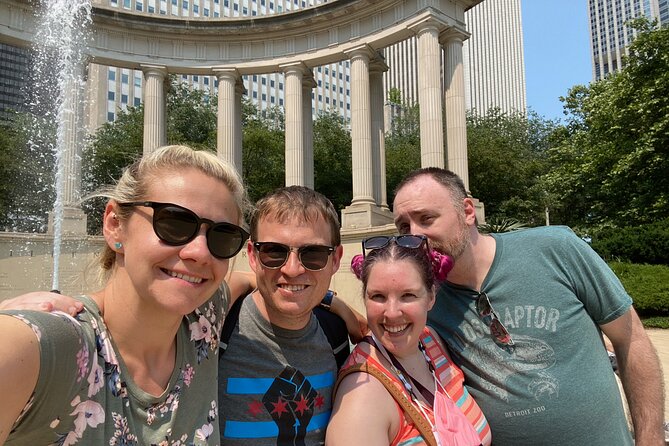
You’ll head to Wrigley Square, which contains the Millennium Monument. It’s described as a nearly full-sized replica of a semicircle of paired Roman Doric-style columns (a peristyle) that originally sat in that area between 1917 and 1953.
This is a clever stop for a game because you can feel the “layers” of the city: what used to be here, what’s been rebuilt or replicated, and what now occupies the space. You’ll be looking around to answer the challenge, which helps you understand the monument instead of just photographing it.
Lurie Garden: built on buried layers after the Great Fire
Lurie Garden is where the downtown story gets more grounded. The game focuses on how the watery site was filled, framed, and decked to its current elevation on the rooftop of a parking garage—using mostly rubble from the Great Fire of 1871. The point is that the garden sits on top of older history.
This stop is valuable because it changes how you interpret the ground beneath you. You’re not just looking at plants and paths; you’re learning that Chicago’s present is literally built over earlier chapters. If you like city stories with a strong “how did this happen?” thread, you’ll enjoy this moment.
Chicago Stock Exchange Arch: a survivor fragment with big symbolism
Another history-forward stop: the Chicago Stock Exchange Arch, one of the few surviving fragments from the Chicago Stock Exchange building designed in 1893. It’s installed outside the Art Institute of Chicago in Illinois.
This is one of those places where the architecture feels smaller than your brain expects—until you realize it’s a fragment that survived. The game’s look-around challenge style makes it easier to treat it as a real artifact rather than a background detail.
Buckingham Fountain: why it’s a must-stop even without a show
You’ll also reach Buckingham Fountain, a Chicago Landmark in Grant Park, dedicated in 1927. The notes emphasize it’s one of the largest fountains in the world, and the location is between Queen’s Landing and Congress Parkway.
In a game format, fountains are tricky because you want clear sightlines and safe access. The payoff is worth it, though: Buckingham Fountain is an instant sense-memory landmark. Even if you’ve seen pictures before, seeing the scale in person is different.
And do plan for real-world access limits. One downside reported in the experience is that getting into the best range near water features can be tough, depending on restrictions or how the area is controlled on the day. If you get stuck, the game may push you toward a hint or a radius adjustment—handy in a pinch, but not as satisfying as pure solving.
Lincoln statue in Grant Park: the mood matters
The route includes a sculpture that depicts a contemplative Lincoln, seated in a chair and gazing down into the distance. The game also notes that it was moved to Grant Park and rededicated in October 2006 in the Sir Georg Solti Garden, near Symphony Center, home of the Chicago Symphony Orchestra.
I like this stop because it changes the emotional tone. After a stretch of art and waterworks, you’re asked to confront a monument with a quieter mood. The clue structure helps keep it from becoming a quick glance.
Taft’s Fountain of the Great Lakes: a finishing stop with first-commission context
Your end point is tied to Taft’s Fountain of the Great Lakes, completed in 1913. It’s described as the first commission of the Benjamin F. Ferguson Fund, established to foster placement of statuary and monuments along boulevards and in public places in Chicago.
This makes a strong finale because it connects the walk back to civic “place-making.” You’re ending where the story feels like public infrastructure—monuments meant to shape how people move, gather, and remember.
Pritzker Military Museum & Library: a sharper turn in tone
One of the route stops includes the Pritzker Military Museum & Library, a non-profit museum and research library for military history on Michigan Avenue. It was founded in 2003, and the notes mention specialist collections related to Winston Churchill and war-related sheet music.
This is a meaningful change of pace. A lot of downtown art walks focus only on design and celebration. Here, you get a reminder that cities also commemorate conflict, study it, and preserve materials that don’t fit neatly into a postcard.
The not-so-perfect parts: walking, phone range, and construction days
This experience works best when you enjoy problem-solving with your eyes, not just your ears. That said, I’d plan with Chicago reality in mind:
- You’re going to walk. This is a downtown route with multiple major stops. Bring shoes that forgive you.
- Game accuracy can be sensitive to your exact position. If you’re slightly off, you might not trigger the next step cleanly.
- Construction happens. If pathways are blocked, you may have to use hints and that can reduce the satisfaction of getting answers on your own.
The good news: the game format supports offline play and flexible pacing, which can help you recover when something is awkward.
Who should book this heist game—and who might prefer something else
This is a great pick if you:
- Want a low-cost way to connect several iconic Chicago stops into one coherent outing
- Like self-paced sightseeing and don’t need a human guide to enjoy art and architecture
- Enjoy puzzle-solving or learning through quick challenges
- Prefer a private, no-crowd experience
You might skip it if you:
- Want guided storytelling from a person every step of the way
- Get frustrated when a phone game requires you to stand in specific spots to progress
- Prefer minimal screen time while walking
Should you book this tour?
Yes, if you’re already excited about Millennium Park and Grant Park landmarks and you like learning by doing. The $7.20 price is hard to beat for a structured walk that ties together big-name public art like Cloud Gate and Crown Fountain with deeper downtown context at places like the Art Institute and the Art Institute’s nearby stock exchange arch fragment.
No, if you hate any kind of “find the right spot” gameplay or you know you’ll be annoyed by construction detours. On a smooth day it’s a smart, fun format. On a messy day, you might lean on hints more than you’d like.
FAQ
How much does Eastside Chicago The Heist Exploration Game and Tour cost?
It costs $7.20 per person.
How long is the tour?
It’s about 1 hour 35 minutes (approximately).
Is there a physical guide with you?
No. It’s designed as a self-guided experience with no physical tour guide and no human contact.
Do I need internet access to play?
No. The game can be played offline, and you do not need an internet connection.
Where does the tour start and end?
It starts at 111 S Michigan Ave, Chicago, IL 60603, USA and ends at Fountain of the Great Lakes, E Jackson Blvd, Chicago, IL 60603, USA.
Can I start whenever I want?
Yes. You have full flexibility to start at any hour, and the tour is available to book 24/7, every day of the week. You can also pause and resume later.
Is this tour private?
Yes. Only your group participates, so it’s private.
What language is the experience offered in?
It’s offered in English.
Can I cancel for a full refund?
Yes. You can cancel up to 24 hours in advance for a full refund. If you cancel less than 24 hours before the start time, the amount paid is not refunded.
Chicago Without the Group
- Medieval Torture Museum Ticket with Audio Guide and Ghost Hunting★ 5.0 · 962 reviews
- Chicago Self-Guided Audio Tour★ 4.0 · 9 reviews
- Chicago’s Gold Coast Hidden History: A Self-Guided Audio Walk★ 4.5 · 7 reviews
- Chicago Riverwalk Self-Guided Walking Tour★ 4.0 · 6 reviews
- Haunted Chicago Exploration Game and Tour★ 4.0 · 6 reviews
The Wider Chicago Shortlist
- Chicago Architecture River Cruise★ 5.0 · 15,756 reviews
- Chicago River 90-Minute Architecture Tour★ 4.5 · 9,629 reviews
- Chicago River: 1.5-Hour Guided Architecture Cruise★ 4.8 · 8,046 reviews
- Chicago: Gangsters and Ghosts Walking Tour★ 5.0 · 7,155 reviews
- Chicago Architecture Center River Cruise aboard First Lady★ 5.0 · 5,536 reviews
The Ink Is Still Wet on These Chicago Reviews




Self-Guided Tours, compared.
 ★ 5.0Medieval Torture Museum Ticket with Audio Guide and Ghost HuntingFrom $35962 reviews
 ★ 4.0Chicago Self-Guided Audio TourFrom $69 reviews
 ★ 4.5Chicago’s Gold Coast Hidden History: A Self-Guided Audio WalkFrom $77 reviews
 ★ 4.0Haunted Chicago Exploration Game and TourFrom $76 reviews
 ★ 4.0Chicago Riverwalk Self-Guided Walking TourFrom $146 reviews
 ★ 4.5Chicago Millennium Park Self-Guided Walking TourFrom $145 reviews
 ★ 3.0Chicago’s Storied Neighborhood: An Audio Tour4 reviews
 ★ 5.0Self-Guided Chicago Loop Tour Explore the City at Your Own PaceFrom $93 reviews
Browse the lists this tour appears in